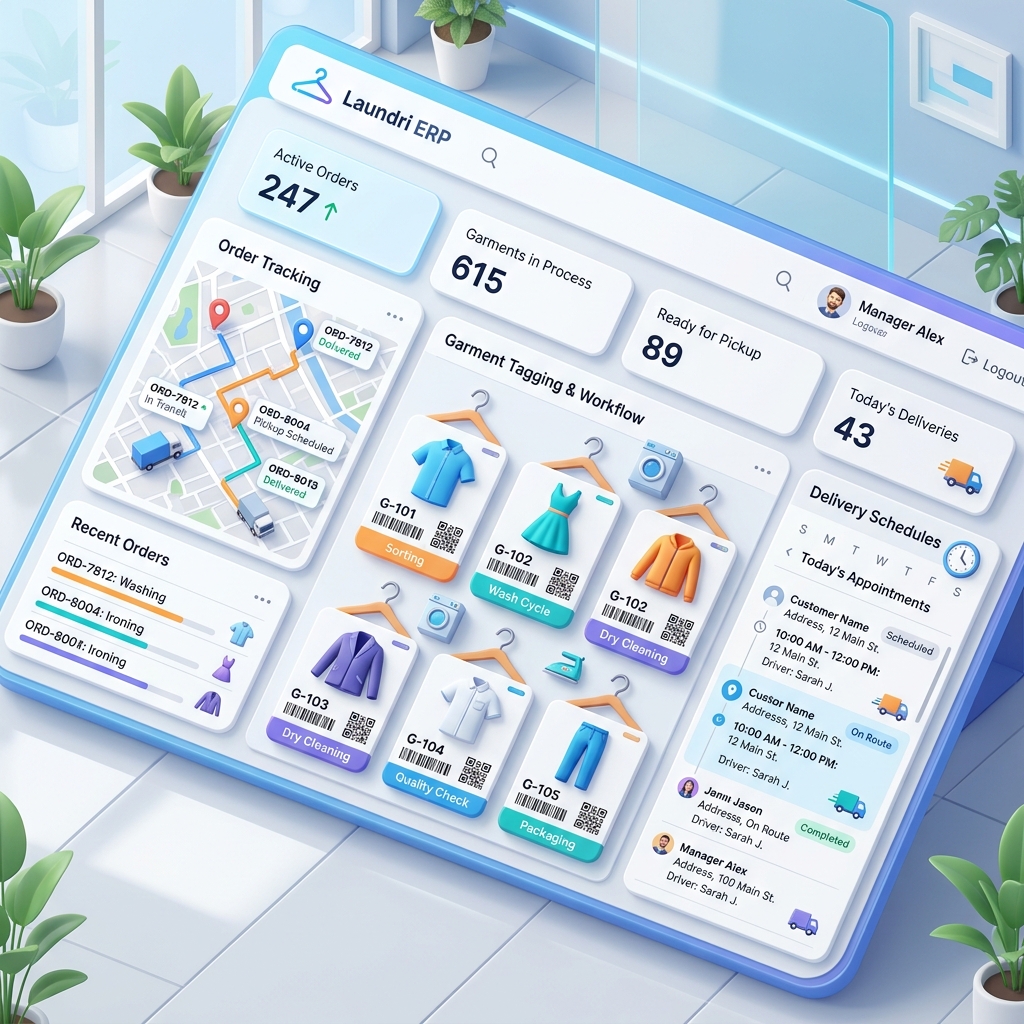
Laundry businesses vary more than outsiders expect. A retail shop taking walk-ins, a commercial operation serving hotels on contract, and an in-house hotel laundry have different economics, different customers and different software needs.
Evaluating before establishing which you are produces a system that fits nobody.
Map your process before looking at any product
On one page, write down what physically happens, in order, from a garment arriving to it leaving. For most operations something like: intake, tagging, sorting, treatment, wash, dry, press, quality check, packing, dispatch, delivery.
Then mark, for each step: who does it, whether anything is recorded today, and what goes wrong most often.
This page is your evaluation criteria. A demo that cannot follow it is a demo of somebody else's business.
Retail laundry and dry cleaning
The customer is an individual, the relationship is transactional, and disputes are about specific garments.
- Fast intake — tagging that staff will not skip when there is a queue
- Both per-piece and per-kilogram pricing, in the same order
- Pre-existing damage recorded at intake, ideally with a photograph
- Customer-facing status they can check without phoning
- Advances, packages and wallet balances that reconcile
Commercial and contract laundry
The customer is a business, volume is high, and the disputes are about counts and invoices.
- Contract rate cards per client, with different rates per item type
- Bulk intake by count and weight, with a documented discrepancy process — this is where contract disputes start
- Linen tracking by client, because stock belongs to the customer
- Loss and damage attribution against contract terms
- Periodic consolidated invoicing rather than per-order billing
- Scheduled collection and delivery routes
The discrepancy process matters most. When your count and the client's differ, what the system records at intake determines who absorbs it.
Hotel and institutional in-house laundry
No external customer — the system is a cost control and availability tool.
- Par level tracking per linen type and location
- Circulation status: in use, soiled, in process, clean stock
- Rejection and retirement tracking, since linen has a finite life
- Department-wise cost allocation
- Integration with the property management system, if there is one
Test these specifically in any demo
- Intake of a mixed order — per-piece and per-kilogram together, one bill.
- A garment failing quality check and going back for reprocessing. Does the system record it as rework, or does it disappear?
- A customer calling about an order mid-process: how precisely can the counter answer?
- A failed delivery — what happens to the garment and the record?
- A damage claim, from report to resolution to whatever credit is issued.
Items two and five are where most systems are thin, and they are where margin and customer trust are lost.
Practical considerations
- Hardware. Tag printers and scanners need to survive a humid, hot environment. Ask what others use.
- Offline behaviour. Intake cannot stop because connectivity did.
- Staff literacy and language. The counter and plant staff are the actual users. If the interface assumes comfortable English, adoption will be poor regardless of features.
- Delivery staff app that works on a basic phone with patchy data.
About the author. Kislay Chandan has worked with schools since 2014. Rather than gathering requirements from the outside, he worked inside a school to see what actually goes wrong day to day, and built what he found into the software. He still works with Shemrock Glitters in Patna — most changes to the product start with something that came up there.
Gallery