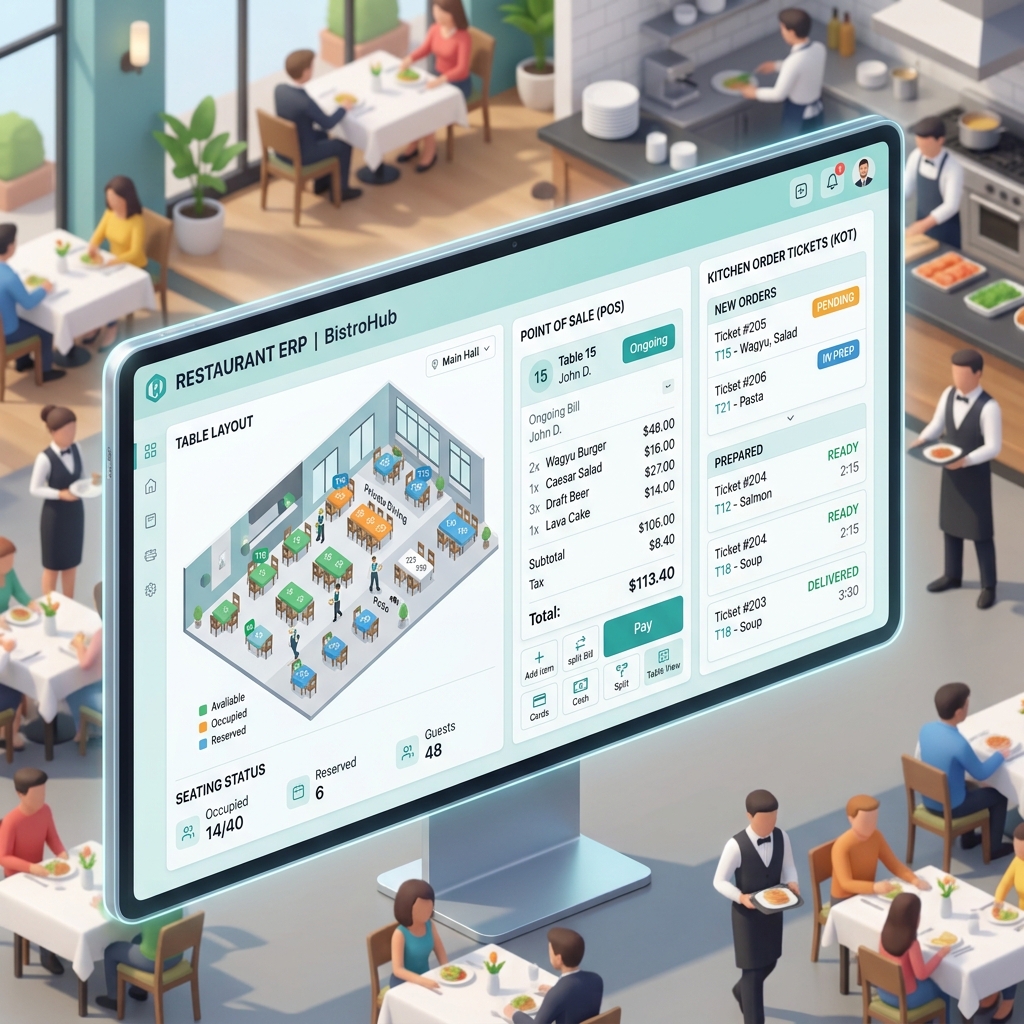
A restaurant POS that only takes orders and prints bills is a cash register with a screen. The margin is in what happens around the order — and that is usually the part left unconfigured.
Recipes never get mapped, so food cost stays a guess
The system tracks dishes sold. It does not track that each one consumed 180g of chicken, 40ml of cream and a portion of gravy, because nobody built the recipe. Without that link, inventory is counted in packets while sales are counted in plates, and the two can never be reconciled.
Mapping recipes is tedious — a week of kitchen work for a mid-sized menu — and it is the single highest-return setup task in the whole implementation. It is what turns "we think food cost is around 32%" into a number per dish.
Modifiers treated as separate items
"Paneer Butter Masala" and "Paneer Butter Masala (less spicy)" entered as two menu items means the sales report splits one dish into two lines, and the recipe link breaks for one of them. Extra cheese entered as a free-text note means it never gets billed.
Modifiers need to be a structured layer above the item: priced where they cost money, free where they do not, and always rolling up to one dish in reporting.
Aggregator orders reconciled by hand
Delivery platform orders arrive on a tablet, get punched into the POS manually, and at month end someone compares a platform statement against POS sales in Excel. Commission, cancellations, promo funding and payout timing never quite line up, and the difference gets written off because chasing it costs more than it recovers.
If the volume through aggregators is material, integration is not a convenience feature — it is the only way the reconciliation ever closes. Ask specifically which platforms are supported and whether the integration pulls the payout statement, not just the orders.
KOT routing decided after installation
One printer in the kitchen, so the bar tickets print there too and someone walks them over. Or every station prints every item. It sounds minor until a busy Saturday, when the routing is what determines whether food and drinks arrive together.
Decide the stations, what routes where, and what happens when a printer is offline, before the hardware is mounted.
Nobody audits discounts and voids
Every POS allows a discount or a void. Few restaurants review who used them. A staff member voiding items after payment is one of the most common forms of loss in the industry, and it is invisible unless someone looks.
Require a reason code, tie every discount and void to a logged-in user, and review the report weekly. The review matters more than the restriction — knowing it is looked at changes behaviour.
Inventory counted at the wrong level
Counting "Chicken Curry" is meaningless. Counting chicken, oil, onions and gas gives you variance: what the recipes say you should have used against what actually left the store. That gap is where waste, over-portioning and theft show up.
Start with the twenty items that represent most of your spend rather than trying to count everything. A partial count done weekly is worth far more than a full count done never.
What separates the restaurants that get value
It is not menu size or turnover. It is whether someone owns the numbers — looks at food cost variance, at the discount report, at which dishes actually make money — every week. The software makes that possible in ten minutes. Without the ten minutes, it is still a cash register with a screen.
About the author. Kislay Chandan has worked with schools since 2014. Rather than gathering requirements from the outside, he worked inside a school to see what actually goes wrong day to day, and built what he found into the software. He still works with Shemrock Glitters in Patna — most changes to the product start with something that came up there.
Gallery